Monday, October 30, 2006

Patriots: Win

Yeah baby! Another blowout Patriots performance. Beat the Viks 31-7. The Pats totally threw the Vikings off their game with tons of passing and a swarming defense. When Bollinger replaced Johnson at QB, he was sacked all three downs, losing 20 yards. Ridiculous!

The great part is after the victory, there was little celebration on the Pats side. Belichick was already looking towards the Colts. Same with Brady. They talked about mistakes they made in offense. That's right - after 372 passing yards.

This is what makes a great team. Always being ready for the next challenge. Never get too high or too low. Always looking to learn and improve.

Just let the fans celebrate!

Saturday, October 28, 2006

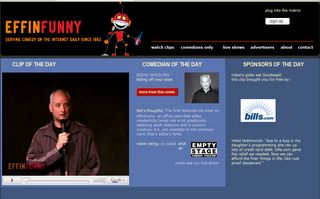
New Comedy Site: EffinFunny.com

Today marks the beginning of a new era... when robots take control over the world of comedy...

OK, so I'm not as funny as Sandeep, the man behind the robot.

Wouldn't you like to get your comedy fix every day? It's just like what has happened with music, now we can see and laugh at material that we truly enjoy. There will be a new clip every day, with a huge archive of material. Fans can rate and comment, even communicate with their favorite comedians. Moreover, there will be sketch comedy, improv, and maybe even a few shows.

This new site opens a new world for up and coming comedians. EffinFunny is what you'd expect - edgy comedy that makes you think. The comedians are hand-selected and filmed at the Empty Stage in LA. Then the material is edited down to its sharpest material. This site will redefine comedy by giving great opportunity to high quality comedians by giving their material great exposure. There will be profile pages and schedules where you can see them live.

And yes, my crew at Position2 had a lot to do with this. We conceptualized it with the creator, put the pieces together and even got one of our clients to sponsor the site. Next we'll help spread the word. The name is a hit...the site will be even better. Call us to learn more.

Right now, the site is in beta so we're still testing and fixing a number of items. The clips work, the functionality will get there quickly. So be a little patient and give some constructive criticism. Click on the ads, too.

Check it out at http://effinfunny.com

Ok, if you don't it there, try http://beta.efinfunny.com/beta

Tuesday, October 24, 2006

Best Line of the Day

This was the most memorable line I've heard in a while,

"I'm not going to chew yesterday's breakfast,"

-Jim Leyland, manager of the Detroit Tigers about "the Smudge" on Kenny Rogers' hand in Game 2 of the 2006 World Series.

Thursday, October 19, 2006

Newspaper Ad Sales Decline

A number of articles in the Wall Street Journal and the NY Times discuss the decline in newspaper advertising. Here's a quote from today's NY Times article:

"Advertising sales continues to sag at major newspaper publishers, judging by the quarterly results reported today by The New York Times Company and the Tribune Company, owner of the Los Angeles Times, Chicago Tribune and Newsday.

For the third quarter, The Times Company’s overall revenue declined to $739,6 million, 2.4 percent less than the comparable quarter last year, mainly because of a 4.2 percent fall in advertising revenue, the company reported. At Tribune, revenue fell to $1.35 billion, a 2.5 percent decline from a year earlier; revenue from print advertising fell 2.2 percent, mostly because of weak sales at Newsday."

The explosion of online media, advertising and classifieds is reducing the share of spend in newspapers. For example overall advertising spend is forecast to be in the low single digits whereas search advertising is in the 20-30% growth range. This makes sense. First, the eyeballs are moving. Fewer and fewer read the newspaper when there is searchable and customizable content on the web. Second, why bother culling through a reams of tiny print when you can search for a car, home, or baseball tickets using a local search engine or a free listing service like Craigslist.

You can even see some desperation on the part of newspapers. I still get the Wall Street Journal paper delivered at home (there are certain places where the laptop is not feasible). I noticed that the vaulted Journal now has cheesy color ads on the front page and editorial section. The need to make up for lost dollars is so great that ads show up where no self repecting editor would have ever allow them. The next thing is to have paid logos/mini-ads of the reported companies in the actual article.

Still, if the content can be of high quality online, smart journalists will do well. The distribution infrastructure will diminish and the online ads can be tracked more effectively. That would command a premium vs. other sources for ad placement. Moreover, like nytimes.com, wsj.com and ESPN Insider, subscription fees can go directly to the bottom line as opposed to subscription fees that only pay for the actual paper and distribution. In the end it is about strong content, the normal AP reporting has less value online unless it is breaking news.

The challenge will be for the traditional newspaper will be to find it's strongest niche. Today, it was reported that the NY Times is losing money on the Boston Globe, a paper it purchased in $1.1 billion . Why read the Boston Globe when the NY Times general online content is better? So, the Globe has to focus more on deep local analysis and sports outreach online. This is something that it really has not tapped. While there are good articles, polls, and chat online, I know the ads are tuned effectively to the reader. The current online Globe Sports section has this awful bowling ad that eats the screen. If they were smart, they would know I'm a Sox fan from California and give me something more relevant to me - ad to buy 2007 A's - Red Sox tickets.

Because things that were forecasted in the mid 90s are finally happening this whole area will be very exciting to watch.

Monday, October 16, 2006

Russian Power

After many years as a superpower, Russia has risen again. While not superpower that previously threatened the US and the Free World, but Russia is definitely in a stronger position with its special form of centralized democracy and capitalism. 2 areas define its power - oil + military weapons.

As oil and natural prices have risen, Russia has used its position to take control of Russian energy companies (e.g. Yukos) and surrounding states like Georgia and the Ukraine. This new energy wealth has strengthened a country that was once seen as a step-child at G-8 meetings.

An overlooked area is military weaponry. While traditional Western powers like the US, Britain and France supply much of the world weapons, Russia has not necessarily reduced its capability or sales. In fact, take a look at the bottom of this page to see the list of high tech arms sales to China, India, Indonesia and Nepal. There's everything from a new destroyer which China could use to threaten Taiwan (and by proxy the US), helicopter sales to India, warplanes to Mexico and Brazil, and anti-aircraft missiles to Nepal.

Military weaponry not only provides jobs and hard currency, it also funds the development of high technology and of course...new weaponry. Moreover, the client country is bound to the weapons supplier for spare parts. As we've seen in Iran with its airplanes - no parts, lots of problems.

Combined with the ability to withold energy, you now can influence countries in ways that may not make sense to a rational outsider. Would Mexico or India side with the US on proliferation is Russia is against it? If the West wants to isolate a country for belligerent activity, Russia can prevent action if that country is a client.

It's all an intertwined set of interests that grow more complex every day...

When Putin came to power, Bush said he could read into his soul. He felt that Putin was trustworthy. Interesting...a former head of the KGB running the country. With no democratic tradition in the country, did anyone believe he would tolerate free speech. Today (10/17) I heard on NPR that many NGO's in Russia are now illegal because they were late in applying for permits. Permits. If you don't register, you are now illegal (check out the NYTimes article on it). With many of the media outlets now state controlled, it is hard to see how democracy can exist or grow.

Again, more complex...

For example (on 10/17) I heard on NPR that many NGOs in Russia are now illegal because they were late in getting permits

Position2: MIT Open Courseware Project

Nothing gets me more excited than to announce our latest client, the MIT OpenCourseWare Project (OCW). We are providing Search Engine Marketing (SEM) services including Search Engine Optimization (SEO), Pay Per Click Advertising (PPC) and Link Building to improve visibility to the over 1400 courses that are part of this project. Our team is especially proud to do this work because students and educators can get free access to super high quality MIT course material.

Already, as a result of Position2's work, MIT OCW has received more clicks in 1 day than they had in the previous month. Even critical works like this need to be marketed to the world. People need to know you exist when they search for your topic.

About MIT OCW

In 1999, MIT Provost Robert A. Brown asked a committee of MIT faculty, students, and administrators to provide strategic guidance on how MIT should position itself in the distance/e-learning environment. The resulting recommendation -- the idea of MIT OCW -- is in line with MIT's mission (to advance knowledge and educate students in science, technology, and other areas of scholarship that will best serve the nation and the world in the 21st century) and is true to MIT's values of excellence, innovation, and leadership.

Now over 5 years from conception the MIT OCW has grown into a large-scale, Web-based publication of the educational materials from the MIT faculty's courses. MIT OCW provides users with open access to the syllabi, lecture notes, course calendars, problem sets and solutions, exams, reading lists, even a selection of video lectures, from 1400 MIT courses representing 34 departments and all five of MIT's schools. The initiative will include materials from 1800 courses by the year 2008.

OCW Accolades....

"Students need to know about this," says Kunle Adejumo, a student at Ahmadu Bello University in Nigeria. "I couldn't find the information I needed (for a metallurgical engineering course), so I went to OCW.

"Your OpenCourseWare is an amazing and remarkable step! I am currently a student of computer science at BRAC University of Dhaka, Bangladesh, and I find it very much useful to learn about my courses. I have always had a dream to study at MIT, since I came to know about the institution, its unique teaching methods, but for many reasons I am not able to do so. This initiative gives me the opportunity to self-teach myself. At least I can reach what MIT teaches to their students. I feel better to access your course materials, to enrich my knowledge. To be truthful, I cannot find words to explain how I feel! Kind of unexplainable feeling, like the feeling one feels when someone falls in love!" - Maruf Muqtadir, student in Bangladesh

"OpenCourseWare expresses in an immediate and far-reaching way MIT's goal of advancing education around the world. Through MIT OCW, educators and students everywhere can benefit from the academic activities of our faculty and join a global learning community in which knowledge and ideas are shared openly and freely for the benefit of all." - Susan Hockfield, President of MIT

Read more stories about MIT OCW's impact...

About Position2

Position2 is a leading provider of search engine marketing services, serving clients around the globe. The VC-backed company improves lead generation, customer acquisition and brand visibility through pay per click advertising management (PPC), search engine optimization (SEO), and web analytics. With operations in Silicon Valley and Bangalore, Position2 offers a full service, performance-driven approach to agencies and a diverse array of growing companies. Position2 was formed in 2005 and is funded by Erasmic Venture Fund, an innovative US/India VC fund. For more information on Position2, please go to www.position2.com.

Thursday, October 12, 2006

Iraq Comments

Listening to the current administration's "Stay the Course" and denunciation of "Cut and Run" is getting tiresome. Being a Republican does not mean that you support every military adventure, nor does it mean that a change in tactics is not necessary to fit with the circumstances. With US troops dying every day in Iraq and the continued lawlessness, you have to wonder if we have learned anything from history.

No matter how benevolent, no one likes an occupier. Pick any foreign occupation at any time in the last couple hundred years and this fact is clear. Look at American history. After a while, the British occupation made us weary until we found a way to expel them. The people of a country need to run their own land.

Adjusting tactics. By now everyone acknowledges that US post war planning was disasterous. Sen Biden discussed this at length prior to the attack. Iraqis are not able to control their country, so the government continues to rely almost solely on the US (and UK). The logic is that if we just stay in or hell, send in more, eventually we will wear them down and they will be readied. This is clearly not working. We have bred a cycle of dependency where the democratically elected government cannot raise and effective military or police force. So we step into the breach and continue to no end. This makes no sense. Having a deadline will allow the people to know that we are leaving and will force the government to deal with the situation.

Highly leveraged force. With the billions of dollars that we have spent on equipment, material, training, we are still not able to fight decisively against a guerrilla army with cheap remote controlled hand grenades and IEDs. Why? Because they see us and we can't see them. Remember Vietnam - we couldn't find where they were coming from. Remember our own Revolutionary War - we fought behind trees and rocks. The British would march in formation, stand in an open field and shoot. Even their uniforms were designed to stand out. American troops were smart - hide behind, trees, rocks and bushes. Attack, then fall back. The British won just about battle, but kept losing people. Remember our surprise attack on the Hessians at Trenton - same deal. Guerrilla tactics. Eventually, it became too expensive for the British to continue, so they left after the one battle that the Continental Army could win. It didn't hurt that we had some help from the French.

People will not adopt democracy at the barrel of the gun, yet our administration believed that it was true. In our early history, we went through the Articles of Confederation before we signed the Constitution. Our framers added many protections for minority rights and a slow, inefficient, yet thoughful government. However, they were concerned about mob rule. They did not want uneducated people voting. Neither the Senate nor the President were directly elected. Look at other successful nations like South Korea, Japan and Germany. Democracy took time after dictatorship.

Yet we think people will go to democracy because we think it is the right thing for them. We are now missionaries who seek to push our cause by force. This is what happens when you have an unsophisticated attitude toward Foreign Affairs.

We think there is a loss of prestige if you talk to an enemy. This is silly. Nixon's opening of China was pivotal to driving a wedge between Communist China and Communist Soviet Union and is the basis our current symbiotic relationship. Even Reagan held talks with Gorbachev, leader of the "Evil Empire." Pick a country where this non-communicative stance has been taken - Cuba, North Korea, Iran, Syria Venezuela and you can see the negative value of the approach.

Watching what is occurring is painful - $300 billion of our treasure, countless lives, more terrorist recruits - yet no change in approach. Reagan "Cut and Ran" from Beirut, Bush I left after expelling Iraq out of Kumait. I remember Kosovo bombing called "Clinton's War" by many Republican leaders. No one thought the US could win by solely utilizing an air war. But it worked. The leadership turned over. While there is a UN and NATO force in Kosova, it is far less expensive than Iraq. $300 at 6% is $18 billion a year in interest that we and our children need to carry as a result of Bush's War.

What is wrong with declaring victory and moving on? Every country knows that if the US wanted to take action, it could. Why do we have to be responsible for cleaning up? No one could match US military power. Why should be be an occupying force? Countries like Iran, Iraq and Venezuela know that the US is bogged down. If we are freed, then some aspect of leverage will dissipate.

In summary, patriotism is one thing. Foolishness is another. Bush came to the President talking about a humble power with limited presence abroad. Now the US is protecting the world and "saving" 25 million people. For what? They don't want us. It is time to start the process.

A's: Tough Losses, Great Games


Last night I went to the second ALCS game. This time, with my friend, Andy. The A's losses over the past 2 days have been tough. It's no fun to be down 2 games. However, I was encouraged by quite a few things:

- The team had many many opportunities to turn it around. It was not like they were completely shut out at any point.
- The bullpen was largely able to hold the Tigers - only 1 run given up outside of starting pitching.
- Great pitchers in Haren and Harden coming up.
- Every hitter but Thomas and Swisher are getting hits. If those 2 start up, the whole thing turns.

The crowd was electric last night. It was almost as if we willed Kendell, Kotsay and Bradley onto base. No one gave up. It was incredible.

We can take this to 7...

This is all about heart. Are you guided by the moment or the past? After the 2004 Red Sox, I'm convinced nothing is over.

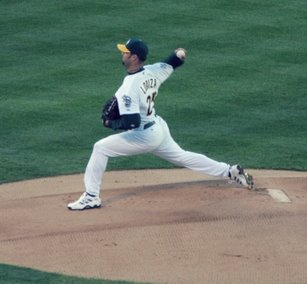
The pics were shot by Andy Drexler using his professional grade Canon from our seat up in Sec 209. Incredible zoom on Loiza and George - a fixture at the park.


Friday, October 06, 2006

Sports: A's Win!!!


Going to the ALCS! Should be a blast. This could be the year! Such a cool team.

Thursday, October 05, 2006

SEM: New PPC Whitepaper

Andreas has released a new PPC whitepaper from his book: Insider SEO & PPC. It is for all those that want to learn about PPC with some nice case studies. We plan to load it on our company website, but until then, download from his book's site.

It is essentially a chapter from his book, so you are getting an important section of his book for free. Now that's a great deal.

We discussed internally whether we should get your contact info before sending you the chapter. It's one of the things we discuss a lot with our clients because some want to capture the lead. Others want to make it freely available (like db40 where you only enter info in if you want info from the message boards). We decided to let people grab it for free without any personal info required. If you want to contact us about ways in which we can help you, then great. If not, we hope that you or your friends consider us in the future. Enjoy and hey, buy the book!

Wednesday, October 04, 2006

Palo Alto: Our First Rain

This is for my friends who live in the East Coast. Today was our first rain. Usually, it's a November thing, but this time it was early. This year, there was a May rain, but usually from April through November, there's no rain. It blows me away. I'm still used to those weekends in New Hampshire when it rains for a whole weekend. That only happens here in the winter.

The good news is that it clears the air. I believe one of the reasons that pollution is such an issue is that particulates tend to linger longer in the air. It's nice every now and then to have it cleared up.

Monday, October 02, 2006

SEM: Myths vs. Reality About PPC (Paid Search Advertising)

Given the prolific amount of opinions on Paid Search Advertising or PPC, I thought it would be helpful to share what we've learned about the field given our wide client base. Since there's a lot of business out there, we thought this would be helpful:

Myths/Reality

You will see results right away.

This is the greatest myth. Many think they will put in a budget, set a keyword price and then hope that it works right away. When it doesn't, they walk away. Others put in really high budgets and burn lots of cash quickly. Sometimes, budgets are not reached and they think there's not enough market for their area.

The reality is to do this in an optimal fashion, there's a disciplined process that can take 1-2 months to get up to speed. During this time, budgets should be set low (but not too low) to learn which keywords and ads pay off. You need to developing and tune landing pages (pages specific to your ad campaign). Many search engines reward successful groups of keywords and push up lower bid keywords to higher positions. Done well, this is a rigorous process that in many cases yields unexpected and surprisingly good results. Sometimes an obvious keyword or ad does not perform well or the "ugly" landing page performs much better than beautiful one.

This is an area that you should see as a long term process that unfolds. It can achieve tremendous results and give you better customer insight. You just need to approach it methodically.

Just use whatever keywords the search engines give you

It's a place to start, but there's a lot more to do. Search engines like Google, Yahoo and MSN have keyword creation tools that will help you turn a few words about your products and services into a wide range of keywords. While helpful, most campaigns suffer from too few keywords rather than too many. Most competitors bid up the most obvious. It is the "long tail" or the somewhat obscure keyword that can make you real revenue and profits. One thing to do is use keywords from one tool and push it into another. Another is to read magazines in your target market and drop those in. Use competitors to search for more or your own log files for how people find you. After you have a wide set of keywords - usually thousands, you have a place to start, group and then cull as part of your setup and optimization process.

It's really easy to run a campaign yourself

You would think that is true after looking at the search engine tools. At first, with a small firm, it may seem easy. However, over time as your campaigns grow, you will find that you spend a significant amount of time managing the campaign. This is especially true in a highly competitive field. Running a search engine marketing campaign involves your site and purchasing process. Skilled operators know advertising, copywriting, design, bid management, optimization statistics, process flows, and analytics. There are firms that will provide a small business version if budgets are modest. There are many firms that will work with you (including ours) if you monthly search ad budget is over $20k.

It's the least expensive form of marketing

It can be very expensive if you do not run your campaign in a methodical manner. There are folks like a kitchen equipment supplier that spent over $100,000 with no benefit. I know another firm that set a $5000 daily budget and blew it in a day with no impact on sales. It can be worse than going to Vegas if you are not careful. Many first timers do not have a landing page or an analytics system to track traffic.

A few years ago, it was different. There was less competition. In fact there was a Piper Jaffrey study that stated that search engine marketing was less expensive than all other forms of marketing: email, banner ads, direct mail. Now that search engines have gained greater prominance, competition has increased and with it, keyword bid costs. The days of penny or nickel bids are over. It is a consequence of greater demand for keywords.

My customer understands what I'm offering

As simplistic as it sounds, many think it is true. You build collateral based on what you believe customers think. You do focus groups. Your marketing team comes up with clever ways of stating your value proposition - redefine the market. The search environment is different. People search for certain sites with particular terms. A TV is a TV, not a next generation viewing sensation. Your message needs to be framed in terms of what people are looking for. The best way to learn about it is to conduct keyword research and then run a campaign where various combinations of keywords, ads and landing pages are tested. You may be surprised with what you discover.

Every search engine runs PPC the same way

This is absolutely false. Each search engine utilizes different algorithms. Some are closed bidding systems like Google and MSN. Some are open bidding like Yahoo. All use previous history to varying extents in their algorithm. Some turn on very quickly. Others take time to get your campaign fully operational.

There's a good reason for why the search engine rejected my ad

We run into this all the time. Some are very tight with trademarked words as keywords or in ads. Others are not. Policies can be inconsistent with the same search engine. This is especially an issue when companies have common words in the company names. One argued with us about using words like "lower, my, or bills." It's good to know someone on the inside.

WikiNews - Good Archive of Objective News

Citizen journalism takes root...

If you blog about various events and use news sources, you use links to the source sites. The biggest problem with it is that the sites tend to archive the article after a relatively short period of time. This allows them to make some cash as the article is then available to Lexis Nexis or other paid archival sources. Wikinews changes all of that. Since the articles are written by voluntary contributors, there's no issue with copyright protection. Also, because it is meant to be open and collaborative, bias can be removed to the extent possible.

As a blogger, it makes life easier, because you do not have to worry about dead links. Learn more about it. It's really cool.

Sunday, October 01, 2006

Politics: Pak ISI Mumbai Bombing - I was in India on their 7/11

The recent news story on how the July 2006 Mumbai bombings were planned by Pakistan's intelligence service, ISI, is worrisome. See the below quote:

“We have solved the July 11 bombings case,” Anami Narayan Roy, the police chief of Mumbai, said during a televised news conference. “The whole attack was planned by Pakistan’s I.S.I. and carried out by Lashkar-e-Taiba and their operatives in India.”

I would be amazed away if this were actually true. Why would Pakistan do such a thing? What do they have to gain? Does this allow them to have internal peace? Does it allow the military to keep control of the country. The whole thing does not make any sense as peace between the 2 countries furthers their economic development. Businesses require security and stability when they make investments. Most make a high level call based on gut feel. While those who are already invested will dig deeper to understand the impact, many just read the headlines. There are 180 countries, just go elsewhere.

I was in India during that week. On Tuesday I was in Bangalore having dinner with my team and investors. We heard about the bombing. I was advised that this would trigger riots and reprisals. It was a good idea to go home. I was scheduled to go to Mumbai on Friday. I called Manju to check into getting me home quickly.

Then the next day, the whole environment changed. There were no riots, Mumbai was functioning. Even the trains were running. There was a state of calm in Bangalore. The streets were full of traffic. We decided to continue with the trip to Mumbai as the airports were running.

After flying over on a full Jet Airways plane, I went to our new offices across the street from Shivaji park. This was in the same area in which there were riots a week earlier over the smearing of mud on a statue (apparently everyone has an ax to grind). Everything was calm. That Friday, plenty of people were walking the streets - same with Satuday and Sunday. People were not even talking about it on the streets - this is, except for on the news channels.

I found Indians to be a resilient people. It was a bit eerie to see restaurants and streets completely full a few days after the bombing. There were no extra checks at the airport. Nothing. It was as if life just went on to the continuous whirling beat. In a city of 18 million where homes and apartments are relatively small, there is really no place to go but to the street. It's too hot and there's too much going on. People have their work, kids have to go to school...people need to live life. A train bombing was not going to stop things. Heck, the trains were running literally hours after the explosion.

In the US, we are not used to life like this. We have had 9/11, the first foreign attack on US soil in 50+ years (no one died in the first one). We are used to relatively calm and safety. Our homes are big enough to stay in for quite a while. In India there has been 3 wars in 60 years. There have been bombings in Kashmir, Delhi and Mumbai. There has been communal violence as well. However, nothing seems to slow down there.

Now that there is this allegation. I hope they have their facts straight. The last thing we need is another threat of war between the 2 countries. It would chill the air and hurt progress in both nations. If it is true, I hope Musharraf takes action. I hope they can move forward towards peace. Let the continuous march of progress move on...

Injuries in Sports - Rising or Not?

I'd love to find out if someone has done a study on whether there has actually been a dramatic injuries in the last 10 years. Doesn't it seem like half of a team is out due to one injury or another. Look at the Red Sox this year: Manny, Coco Crisp, Wakefield, Papelbon, Nixon, Clement, Pena, Gonzalez, Varitek, Wells, etc. I could go through a similar list for almost every pro team.

So what's the cause?
  • Too much practice
  • Not enough stretching
  • Use of performance enhancing drugs
  • Starting competitive sports too early
I see similar injuries with my 10 year old. One day his knee hurts, another day a foot, another an ankle. I think it is due to highly competitive sports. Kids just don't play multiple sports on the playground and after school. Now it's organized. That means repetitive stress to joints, muscles and bones are ever present.

In pro sports, there seems to be a rash after all the stuff about steroids came out. It still is present after drugs were banned.

If someone finds a cool article on this, it would be much appreciated.

Position2: Client Testimonials

Given our rapid build-up, I thought it would be useful to list some of the testimonials we've received from a few of our clients.

“Position2 helped us take our business to the next level. By introducing innovative ideas, fromSEO opportunities to new paid search strategies, Position2 helped us drive tremendous growth while beating our internal ROI measures. The team dedicated to our account works tirelessly to help us succeed... and always seem to have our best interests in mind when driving traffic and growth in our company. Their passion to help us win makes success guaranteed."
-Bradford Stroh, Co-Founder and Co-CEO, Freedom Financial Network

"Position2 has been an essential partner to db4objects success to become the world’s most popular object database. In only 6 months, they have increased our SEO/PPC software downloads by over 100% while keeping customer acquisition cost within the narrow constraints of our low-cost business model. With their help, we have expanded our reach across the globe, especially with campaigns in Asia. Position2 is an integral part of our marketing organization."
- Christof Wittig, CEO, db4objects

"As a new contender in the healthcare space, Search Engine Optimization (SEO) is a crucial marketing strategy for Flagship. Position 2 guided us through our website design and copy, ensured that we are indexed constantly by the major search engines and designed and maintained our PPC campaigns. Stephanie Cota and her team have provided excellent and expeditious service throughout. Their services are both cost-effective and of the highest quality. We continue to expand our business relationship with Position 2 and would be happy to recommend them to anyone who is looking to improve their search engine marketing."
-Katharine Tilston, Director of Marketing, Flagship


"With Position2 we were able to build our worldwide membership base very quickly and effectively. Our cost per new user dropped dramatically, we reached our goal months ahead of time. With SEM, we were able to attract high quality members. On top of that, we were offered high quality service at a cost that fit our budget."
- Anu Nigam, CEO, 411Sync.com

And yes, this will make it to our site. We are going through a redesign.

Why did we wait so long? Clients came first.

Monday, September 25, 2006

Asthma: The First Aperon Biosystems Article

Unfortunately, this article is not available anymore, so I've put it here. We did this interview a long time ago while still in the early days of the company. As you can tell, I enjoy history, especially my own :). I hope the folks at the Merc don't mind:

PERSONAL CRISES BROUGHT 3 BAY AREA FIRMS TO LIFE
When illness leads to innovation
By Michele Chandler

San Jose Mercury News
9/21/2003

Entrepreneur Paul Lovoi of Saratoga was pushing ahead with his latest company, which is developing a device to treat people with a condition that causes blindness. Then, in March, tragedy hit.

His wife of 26 years, Janice, died suddenly after a weakened artery in her brain burst. At his wife's wake, Lovoi vowed to their friends that he would find an easy way for others to detect life-threatening hemorrhagic strokes before it's too late.

[ . . .]

Few inventors create medical devices because an up-close calamity pushes them. They face the same hurdles as other entrepreneurs: needing experience, documenting a void in the market and getting cash.

``Most people who have a personal tragedy aren't adept enough to start a medical device company. They don't have the right background or training. It's a special situation to end up there,'' said Casey McGlynn, a San Jose attorney and prolific fixer of medical device
deals in the Valley.

On average, it takes five years and tens of millions of dollars to get a would-be device from the drawing board to everyday use -- if the Food and Drug Administration gives its approval. And these days, venture capital firms are skittish about putting their money on ingenue developers. They favor business plans, market analysis and sales projections above emotion and personal drive to make a difference.

Perhaps they should consider those other factors, said Patrick Lynn, co-founder of Palo Alto's Rinat Neuroscience.

``Often times, people can make up for that with the passion derived from their personal experience. You don't count them out,'' said Lynn, who has both founded and invested in young health care companies.

Here's a look at three Bay Area firms started by entrepreneurs whose personal crises served as a springboard to invention:

[diabetes content omitted]

MONITORING ASTHMA

Asthma dictated life for Rajiv Parikh as a boy. He vividly recalls the wheezing, the inhalers and an ill-fated vacation to India at age 10 spent riding on his father's shoulders because he couldn't catch his breath in the pollution and heat.

Parikh eventually outgrew the condition. Today, along with his wife, Bhairavi, he's developing a breath analysis device to enable asthmatics to monitor their airway inflammation so they can take the appropriate medicine and ward off a full-blown asthma attack.

It's the first start-up company for Parikh and Bhairavi, who founded Aperon Biosystems two years ago. While they lack prior experience bringing a business online, they both have credentials -- Rajiv earned an MBA from Harvard University, while Bhairavi received a doctorate in biomedical engineering from Worcester Polytechnic Institute in
Massachusetts.

In early 2001, Rajiv had his sights set on founding a wireless company. Bhairavi had a job doing research and development for Natus Medical, a San Carlos maker of products to detect common disorders in newborns. One device under development there screened babies for
jaundice by analyzing the infant's breath.

Bhairavi had done related research involving gas analysis while working on her doctoral thesis. She saw potential for using that technology to detect lung inflammation experienced by asthmatics. So, in 2001, the couple licensed the gas analysis technology from its
inventors -- two UCLA physicians -- and founded Aperon.

``She had worked on this back in her days as a Ph.D., and I had the personal experience'' with asthma, Rajiv said. ``I don't know if it was fate or faith, but it worked very well together.''

The couple set up a small shop in Santa Clara and began lab experiments, bankrolled with $100,000 from the couple's savings, plus $200,000 loaned by family and friends.

One venture capital firm turned down Aperon's funding request. But representatives there put the Parikhs in touch with John Kaiser, a retired executive who had also headed a Sunnyvale start-up. Kaiser became Aperon's CEO late last year.

In May, the company received $4.6 million from two venture funds. So far, the money has been used for a larger office in Palo Alto, to hire staff and to develop a prototype device.

``The intent today is to build a great company that helps lots of people,'' Rajiv Parikh said.

Unbeknowst to me, there was some discussion about this article on a medical info site. Check this out with my response many years later. It's cool because it's a way to catch history online and then reach a current state quickly.

Personal Finance: Managing Money and Getting Out of Debt

I consider myself lucky to have been raised by parents who were obsessed about saving money and keeping spending low. That allowed me to save a lot early in my career - we used to live on base pay and bank our bonuses. That saved us when I went to HBS and started companies in the Bay Area. I must say that we did rack up a lot of debt. A lot of folks have asked me about strategies we used. So instead of reinventing the wheel, I'll let you read some articles by my friend Brad Stroh, co-founder of Bills.com - a site that gives practical advice & tools on personal finance (listen to his podcast). If you need a particular service like debt consolidation or refinance, they hook you up with a host of trusted independent firms. They even have this Ask Bill feature where you can ask questions and get personal responses. Brad's passionate about this stuff.

Check these out:

Hone Your Debt Consolidation Savvy -Top 10 situations when debt consolidation is a smart move-

When Second Mortgages Make Sense
- Making the most of home ownership – without betting the farm

6 Steps to Getting Out of Credit Card Debt


Level the Playing Field With Collections Agencies for Fair Debt Payment
- What to do when a debt collector calls -

Home Loan Tips: Avoid Mortgage Troubles, Other Pangs of Rising Interest Rates
- Bills.com outlines 9 tips to prevent problems, avoid foreclosure -


Before ‘Medical Bankruptcy’: Consumer Options Can Salvage Credit

Friday, September 22, 2006

Position2: greendimes - end junk mail & plant trees

I have to talk about this new client... Today we signed up greendimes, a business with a significant social benefit. For a dime a day, they will eliminate your junk mail and plant a tree for you every month. That's is, $36 a year - a ridiculous value.

I was one of the 1st customers, not because they were a potential client, but because it was a slam dunk. Get rid of the junk mail nightmare, lower the number of trees chopped, energy consumption and the bonus is to plant a tree. It drives me crazy to have so much junk mail. A lot of times, it overflows out of our mail box. We've actually thrown away real mail - checks and bills.

Pankaj Shah, the founder and super successful entrepreneur, has gotten the attention of the socially conscious Hollywood. Lot's of well known names will become members.

We are running the SEO, PPC and Blog Outreach campaigns. It's fun for us because the value proposition is so strong. There's so much excellent content in this area. I can imagine tons of people signing up with the company. Check out their blog as they are putting together great articles.

I really hope that we can sign up more like this - great businesses with strong societal benefits.

Sign up and give a dime!

Position2: How People See Us

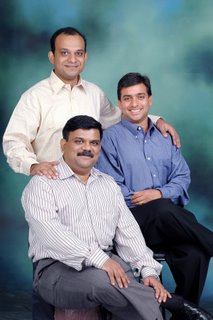
Want to know a little more about Position2? Here are photos of the Position2 management team.


Rajesh Sule
is sitting to the left. He heads Business Development and Marketing. Vinod Nambiar (standing) heads our Global Delivery or Operations group. Super guys - highly experienced execs. They build very loyal teams and are creatively brilliant.


Here is Andreas Ramos who is our Search Engine Marketing expert on PPC and SEO. He comes up with a lot of new ideas for us to build technologies and processes. He and Stephanie wrote the seminal book on Search Engine Marketing: Insider SEO and PPC. He's written a ton of other books as well. Andreas' website and newsletter has a huge following. He writes about anything in an engaging way and is a true Renaissance Man. By the way, he rarely dresses up as he's still a Valley engineer at heart.


Here is Stephanie Cota who is our Analytics and E-Commerce expert. She's an out-of-box thinker who is great with clients. If you buy her book from here, she might even sign it.

Unfortunately, I do not have Soumya Ravi and Rakesh Varma's pictures. They are so busy with Clients (Soumya) and Technology (Rakesh) that neither have time for pictures. Both are stars in their own right and minds :) .

I also do not have a picture for Manju yet. She keeps the trains running on time around the world for the company. Manju is invaluable to us.


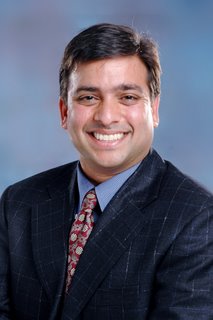
Here's me in a suit. This is an unusual thing since now I'm a Silicon Valley guy. It reminds me of my old days in sales at NCR. I'm sure they would have objected to the fact that I didn't have a white shirt :)

I had these shot when I was in India. The price was the same in currency units at a Bangalore professional studio as it was in the US. The only difference was the rupee was 45 to 1. That's right, the cost was about 98% off. Too bad you can't build a startup off of that.