Recently, Google announced universal search where it would be integrating video, news, image and other results into Google search results. In and of itself it's a good user-centric idea because very few people actually click the tabs to other sections. Something like 95+% of all Google traffic is still Google Web Search.
However, now Google has found a way to make more money on its ads while retaining you on its site. Try the search for "zelda spoof" produced by our friends at EffinFunny. There, you will see on result 3 the EffinFunny clip.
Now click on "Watch Video"... That's right on the same Google results page, you will see the video through the YouTube player.
That's triple advantage Google:
1. Google's search ads are still displayed on the right side, click there and more cash flows to Google.
2. YouTube gets promoted - not bad for a Google property
3. Google gets to increase it's stats for "time on site" a metric that influences how much advertisers play.
Now when Google integrates DoubleClick, they can also display branded banner ads as most ads for video content is less context-driven and more brand driven. They will also be pressured to prioritize content on their site over others. Google is already engaging in cross-selling by showing the Google Checkout icon next to users of their Checkout service drawing your eye to the result.
Most importantly, even if the originators of the content - in this case EffinFunny - would have less of an opportunity to monetize their content. They can look more like a portal disrupting their implied partnership with site, "You make money when they click. We make money on ads next to your listing."
Hopefully, Google is smart about this and finds ways of sharing revenues and not prioritizing YouTube over others. But as you get bigger and more MBA driven, that does not necessarily happen. It's not a medica concentration monopoly case yet, but 5 years from now, it may be...
Saturday, May 26, 2007


Saturday, May 19, 2007
Tesla Motors - Pure Marketing Insight
There's a lot of hype about Tesla Motors. The new wave electric car looks fantastic and is backed by Elon Musk (founder of PayPal and Zip2), Sergei Brin and Larry Page and a bunch of Silicon Valley venture capital firms. This is looking like the 1 electric car that will be successful. Why? Because it is designed to leverage fundamental technologies like lithium ion batteries, lightweight aluminum components, highly reliable electronics, and electric motors to build a beautiful sports car that already has a waiting list amongst the rich and famous.
That's what most would make you believe. What it's really about is that the founders Martin Eberhard and Marc Tarpenning saw the market for this using the Silicon Valley technology lifecycle mindset. Build a product that people really want. Essentially, they knew the difference between niche marketing and mass marketing. In the past, people would try to build an electric car for the masses to satisfy regulators. GM's failed EV1 electric car is a perfect example of an underpowered, overpriced, low capacity vehicle that people did not really want unless they were willing to make lots of sacrifices. Instead Tesla's founders decided to give people what they really want - a fast car that looks fantastic and has the kind of range that fits the class of car that the target buyer would want. They used the strength of the electric motor to build a better car. It's classic "Innovator's Dilemma:" build an exclusive sports cars on a Lotus platform that can go from 0-60 in 4 seconds with over 200 miles range on a charge. Oh and as a bonus, you get low operating cost of 2 cents a mile and a car that would need low maintenance as with an electric motor there's only one moving part - the rotor. No fan belts, radiators, spark plugs, valves or muffler this was a simpler machine.
Moreover, they saw the marketing advantage that comes from building something a head turner that is exclusive to the wealthy few. With so many conscious about climate change and reducing dependence on foreign oil, this is an easy purchase to feel good about.
Tesla can march down the cost and learning curve of integrating these technologies. They can learn more about how these come together before the pressures of volume and a mass audience. Theyh can learn about what feature as most important to actual buyers.
Tesla has used a Silicon Valley approach to building the product by outsourcing the components from many suppliers and having the car produced by Lotus. That's right, this car company has less than 80 people - that's amazing.
They've done a brilliant marketing job by making this a competition to get on the waiting list. Typically, you don't want to be the first one to deal with the inevitable first production kinks. Now people are fighting for their place. Tesla's site is high end with a great product configurator. They marketed themselves well by getting reviews from a wide array of reviewers early in the process to build buzz. Their blog has an excellent variety of posts from the CEO on down. Obviously, people are reading it as there is a long line of comments for each post.
Telsa has turned the traditional negative trade-off notion of the electric vehicle on its head. Electric is the trade-on.
I can't wait for the 4 passenger version!
That's what most would make you believe. What it's really about is that the founders Martin Eberhard and Marc Tarpenning saw the market for this using the Silicon Valley technology lifecycle mindset. Build a product that people really want. Essentially, they knew the difference between niche marketing and mass marketing. In the past, people would try to build an electric car for the masses to satisfy regulators. GM's failed EV1 electric car is a perfect example of an underpowered, overpriced, low capacity vehicle that people did not really want unless they were willing to make lots of sacrifices. Instead Tesla's founders decided to give people what they really want - a fast car that looks fantastic and has the kind of range that fits the class of car that the target buyer would want. They used the strength of the electric motor to build a better car. It's classic "Innovator's Dilemma:" build an exclusive sports cars on a Lotus platform that can go from 0-60 in 4 seconds with over 200 miles range on a charge. Oh and as a bonus, you get low operating cost of 2 cents a mile and a car that would need low maintenance as with an electric motor there's only one moving part - the rotor. No fan belts, radiators, spark plugs, valves or muffler this was a simpler machine.
Moreover, they saw the marketing advantage that comes from building something a head turner that is exclusive to the wealthy few. With so many conscious about climate change and reducing dependence on foreign oil, this is an easy purchase to feel good about.
Tesla can march down the cost and learning curve of integrating these technologies. They can learn more about how these come together before the pressures of volume and a mass audience. Theyh can learn about what feature as most important to actual buyers.
Tesla has used a Silicon Valley approach to building the product by outsourcing the components from many suppliers and having the car produced by Lotus. That's right, this car company has less than 80 people - that's amazing.
They've done a brilliant marketing job by making this a competition to get on the waiting list. Typically, you don't want to be the first one to deal with the inevitable first production kinks. Now people are fighting for their place. Tesla's site is high end with a great product configurator. They marketed themselves well by getting reviews from a wide array of reviewers early in the process to build buzz. Their blog has an excellent variety of posts from the CEO on down. Obviously, people are reading it as there is a long line of comments for each post.
Telsa has turned the traditional negative trade-off notion of the electric vehicle on its head. Electric is the trade-on.
I can't wait for the 4 passenger version!
Wednesday, May 02, 2007
Can't Deny This About Bonds
Tonight Barry Bonds hit his 9th home run of the season and is now only 12 away from Aaron's record. Whether he once took steroids or not, no one can deny he is one of the greatest home run hitters of all time. With all the scrutiny and drug testing, he is hitting .345 at the age of 42 and on a ridiculous home run pace of 60.
Everyone thought that with his last 2 injury-ridden unproductive seasons that it was the effect of the new drug testing program. When the steroids are gone, the production would fall. Well, that has not been the case. Bonds is better than ever.
Say whatever you want, he's a great player. I plan to go to a few this year.
Everyone thought that with his last 2 injury-ridden unproductive seasons that it was the effect of the new drug testing program. When the steroids are gone, the production would fall. Well, that has not been the case. Bonds is better than ever.
Say whatever you want, he's a great player. I plan to go to a few this year.
Tuesday, May 01, 2007
Simple Governmental Rules to Reduce Emissions and Decrease Foreign Oil Dependence
As many of you know, I'm a fan of the free market and less regulation, but given the need to reduce dependence on foreign oil and limit global warming emissions, there are 4 inexpensive items that the DOT and the EPA could adopt for vehicle owners. Each on their own would have significant impact, but on a network wide basis could have a substantial impact on reducing oil consumption and costs to American consumers:
1. E85 everywhere: If each vehicle by model year 2010 could be mandated to be E85 certified, it could allow the US to have greater flexibility against future increases in oil prices. The cost is relatively minor as it's about adjusting fuel lines and gaskets - less than $150 in parts. It would also provide a market for fuel stations to provide ethanol-based pumps to stations around the country. In Brazil, they have created an incredible market for sugar, benefiting their own farmers and countrymen rather than those from unstable oil-rich countries.
2. Tire Pressure Sensor: This would do 2 things, reduce potential accidents and improve gas mileage. Having an accurate tire pressure sensor system could could have an incremental yet significant cumulative effect on gasoline consumption. A few percentage points reduction that change the supply demand picture dramatically. How much does a sensor cost? Very little in mass production.
3. Laser Guided Cruise Control: Cruise control is a nifty little feature when the reads are uncongested. However, anytime there's a little bit of traffic, it uses utility. Laser guided systems slow down to match the speed of the car in front of you. It slows down faster than a human would, making it especially useful in when there's a slowdown. There are studies that have been run that show that if 20% of cars were using this feature, it would reduce traffic congestion dramatically as fewer cars would jam the brakes and cause the typical cascade effect. In many cases, it could eliminate certain areas of congestion altogether. This would have 3 impacts - 1. Increase gas mileage as there would be less idling, 2. Increased productivity as less time would be spent on the roads and 3. Longer road life as it effectively would increase capacity.
4. Electronic Toll Sensor: As inefficient as tolls are from an economics point of view, they are reality. If every car had a toll sensor that would automatically debit a driver's account, it would cut toll congestion dramatically and speed travel throughout the country. We should pick a standard and make it nationwide.
All four items presented about are relatively inexpensive, especially if mandated in volume. It could have dramatic impacts on fuel consumption, leverage with oil producing countries and our quality of life. A 10% increase in fuel efficiency could dramatically impact prices especially during scarcity. Before we change the world with hybrids and hydrogen, why not implement these changes now.
1. E85 everywhere: If each vehicle by model year 2010 could be mandated to be E85 certified, it could allow the US to have greater flexibility against future increases in oil prices. The cost is relatively minor as it's about adjusting fuel lines and gaskets - less than $150 in parts. It would also provide a market for fuel stations to provide ethanol-based pumps to stations around the country. In Brazil, they have created an incredible market for sugar, benefiting their own farmers and countrymen rather than those from unstable oil-rich countries.
2. Tire Pressure Sensor: This would do 2 things, reduce potential accidents and improve gas mileage. Having an accurate tire pressure sensor system could could have an incremental yet significant cumulative effect on gasoline consumption. A few percentage points reduction that change the supply demand picture dramatically. How much does a sensor cost? Very little in mass production.
3. Laser Guided Cruise Control: Cruise control is a nifty little feature when the reads are uncongested. However, anytime there's a little bit of traffic, it uses utility. Laser guided systems slow down to match the speed of the car in front of you. It slows down faster than a human would, making it especially useful in when there's a slowdown. There are studies that have been run that show that if 20% of cars were using this feature, it would reduce traffic congestion dramatically as fewer cars would jam the brakes and cause the typical cascade effect. In many cases, it could eliminate certain areas of congestion altogether. This would have 3 impacts - 1. Increase gas mileage as there would be less idling, 2. Increased productivity as less time would be spent on the roads and 3. Longer road life as it effectively would increase capacity.
4. Electronic Toll Sensor: As inefficient as tolls are from an economics point of view, they are reality. If every car had a toll sensor that would automatically debit a driver's account, it would cut toll congestion dramatically and speed travel throughout the country. We should pick a standard and make it nationwide.
All four items presented about are relatively inexpensive, especially if mandated in volume. It could have dramatic impacts on fuel consumption, leverage with oil producing countries and our quality of life. A 10% increase in fuel efficiency could dramatically impact prices especially during scarcity. Before we change the world with hybrids and hydrogen, why not implement these changes now.
Saturday, April 28, 2007
More Big Deals for Position2
This week was one of our best weeks ever. We added 4 new clients in PPC and SEO as well as a significant web design and development project for an existing client. This is all because of the ROI our existing clients are seeing with us.
Most notably, one is a major Fortune 100 Insurance and Financial Services company to be their exclusive provider of PPC management services.
We are on a roll!
Most notably, one is a major Fortune 100 Insurance and Financial Services company to be their exclusive provider of PPC management services.
We are on a roll!
Wednesday, April 04, 2007
BizWise Interview
Today I did an interview for a BizWise, a Cisco sponsored segment for small and mid-sized businesses. The show will be on outsourcing. My section was on how even start-ups can begin in a multinational sense. When it comes out, I'll put in a link.
The cool part is that we were able to highlight Position2's unique business model and approach. We are a living example of what Michael Copeland of Business 2.0 (one of the interviewers) call the micro-multinational trend in offshoring. At 50 people, we're not that micro, but great to be part of a new trend.
The cool part is that we were able to highlight Position2's unique business model and approach. We are a living example of what Michael Copeland of Business 2.0 (one of the interviewers) call the micro-multinational trend in offshoring. At 50 people, we're not that micro, but great to be part of a new trend.
Monday, April 02, 2007
Sunday's 60 Minutes
On April 1, 60 Minutes had a segment on government at it's worst - the passing of the Medicare Prescription Drug Benefit. This was a 1000 page bill passed during the dead of the night written by the pharmaceutical lobby. The worst thing about this bill is that Medicare does not have the right to negotiate with drug companies. Drugs like Zocor costs 10x more through Medicare than through the Veterans Administration. Then many of those who worked on the bill got hired for substantial salaries by the pharma industry.
Hey, I'm OK with the pharmaceutical lobby having a fair chance to innovate and profit, but this is a disgusting use of industry money to bilk the taxpayer. Republicans should be embarrassed. A real Republican is for free competition and lower government costs, not for bilking the taxpayer and increasing our debt.
This is definitely no April Fool's.
Hey, I'm OK with the pharmaceutical lobby having a fair chance to innovate and profit, but this is a disgusting use of industry money to bilk the taxpayer. Republicans should be embarrassed. A real Republican is for free competition and lower government costs, not for bilking the taxpayer and increasing our debt.
This is definitely no April Fool's.
Friday, March 30, 2007
The Big Emphasis on Bid Management
When you talk to various search engine marketing firms, they all talk about their toolset. Same with potential investors, "What are you using for a tool?" if you are going to manage 1000s of keywords, how can you do it without an amazing automated tool. People expect all kinds of things out of these tools - they dance, they sing, they do all kinds of things. They have this mysterious black box quality seeing patterns no human can see.
Hmmm...so what's reality?
Well, most tools simply automate a set of rules that are established like: stay within position 1-3 as long as cost is not great than $1. They do not look at portfolio vs. volume. There's only a few that do that. None of these tools write ads, tune landing pages or improve quality score. I can show you the math, but trust me, there are more ways to improve your cost of acquisition then bid management.
Quality score, you ask, what's that? Well, the big search engine folks at Google, Yahoo and MSN don't just take your bid prices and show your ad based on what you're willing to pay. No they are looking for the most they can get per search engine result. That means they care about how many clicks you actually get. They also have their long term interest in mind, so they also evaluate how well your keywords, ads and landing pages match. They also look at how sets of keywords are organized in ad groups. There are even time delay factors. We think there over 50 of these factors. A lot of this has to do with how your campaigns are organized and managed.
So a simple automated tool doesn't completely do the trick. Even a great one does not work if you don't have enough data. This is where processes and highly trained personnel come in that work in a holistic way from strategy to keyword to click to lead to revenue. Bid management is important, but it's only one part of the elephant. Beware of those that seek to rope you in with fancy sounding technology, because this stuff is a lot of detailed effort that only works when there's a lot of focus on the campaign.
And yeah, we do have one of those more advanced ROI based portfolio optimization tools...
Hmmm...so what's reality?
Well, most tools simply automate a set of rules that are established like: stay within position 1-3 as long as cost is not great than $1. They do not look at portfolio vs. volume. There's only a few that do that. None of these tools write ads, tune landing pages or improve quality score. I can show you the math, but trust me, there are more ways to improve your cost of acquisition then bid management.
Quality score, you ask, what's that? Well, the big search engine folks at Google, Yahoo and MSN don't just take your bid prices and show your ad based on what you're willing to pay. No they are looking for the most they can get per search engine result. That means they care about how many clicks you actually get. They also have their long term interest in mind, so they also evaluate how well your keywords, ads and landing pages match. They also look at how sets of keywords are organized in ad groups. There are even time delay factors. We think there over 50 of these factors. A lot of this has to do with how your campaigns are organized and managed.
So a simple automated tool doesn't completely do the trick. Even a great one does not work if you don't have enough data. This is where processes and highly trained personnel come in that work in a holistic way from strategy to keyword to click to lead to revenue. Bid management is important, but it's only one part of the elephant. Beware of those that seek to rope you in with fancy sounding technology, because this stuff is a lot of detailed effort that only works when there's a lot of focus on the campaign.
And yeah, we do have one of those more advanced ROI based portfolio optimization tools...
Cool Pitch Slide Show
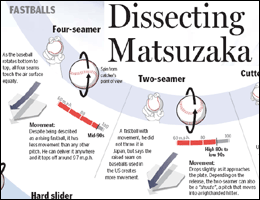
You have to complement the Boston Globe for putting together an excellent slide show on Matsusaka's pitching repetoire. Shows how he holds & throws, velocity, breaks, and how the catcher sees it. The net is so cool in this way. Just makes baseball more fun to watch. Can't wait till they one day add video to all this.
This is why being a Red Sox fan is so cool. You just don't get stuff like this in less passionate sports towns.
Oh yeah, in addition to the view of the famous gyroball in the link, go here to see a cool Japanese cartoon on it.
New Travel Client: ezeego1

We just signed up ezeego1, a new travel bazaar focused on India set up by the well-established UK travel operator, Cox & Kings. This agreement has us a their exclusive digital marketing agency providing our full suite of services + strategic guidance. We expect great growth to occur for them in India and around the world.
Congrats to the team for putting together a win-win for both sides!
Thursday, March 29, 2007
New Client: ResponseLINK

We have already started work with a great new client - ResponseLINK. They have a personal emergency alert service specifically designed for seniors who want to live in their own home yet still have some monitoring. It is a excellent service for caregivers like family and friends who can know that their loved one is doing OK. ResponseLINK's SafetyLINK offering is a personal emergency service, so that if something happens, help can arrive at the touch of a button. Their WellnessLINK and RxLINK services allow for wakeup calls, wellness checks and reminders to take meds. The CompleteLINK service puts it all together for as little as $55/month.
We really like this kind of client because it has tremendous benefit for seniors who want the freedom of living independently yet have care that is unobtrusive. For family and doctors and nurses there is comfort in knowing that the beloved patient has some form of monitoring. For the healthcare system, this can dramatically reduces the cost of care for the growing senior population. It's a win all around.
At Position2, we are very excited about growing this business to take full advantage of the web and search engine marketing so that more people can hear about them.
Tuesday, March 27, 2007
Cracking the Code
I haven't blogged in a while because we've been knee deep in cracking the code for our clients. Part of the game in PPC is in optimizing according to a given goal, whether it's clicks, leads or revenue - that's right revenue. When clients give us access to actual revenue data, we can change our optimization process. That's more than simply adjusting bids - we adjust ads, budgets and landing pages as well.
One finance client gave us a goal to get them a 1000s of mortgage leads and do it quickly. Once we got to the right thresholds, we then managed the costs to actual revenue. This enabled our client to get to the right volume for various lead buyers, then by hitting profitability. The key to this is creating the right search engine account and messaging structure from the beginning. Initially, progress is slow until it just explodes. Once it explodes bringing costs under control is relatively straightforward.
Because we work across multiple industries those same tools and processes can be adapted to each other. For example for an internet dating client, we grew their ad spend 10x while keeping their cost per trial constant. Because they earn a certain proft per trial, this is like getting 10x greater profits - not counting the network effects of having more members. More members mean more revenue opportunities. There are so many examples of this with our clients and others who truly "get" search engine marketing.
It's a blast when the team cracks the code, because now a client can see the true benefits of rapid growth through search engine marketing. PPC becomes a profit engine.
One finance client gave us a goal to get them a 1000s of mortgage leads and do it quickly. Once we got to the right thresholds, we then managed the costs to actual revenue. This enabled our client to get to the right volume for various lead buyers, then by hitting profitability. The key to this is creating the right search engine account and messaging structure from the beginning. Initially, progress is slow until it just explodes. Once it explodes bringing costs under control is relatively straightforward.
Because we work across multiple industries those same tools and processes can be adapted to each other. For example for an internet dating client, we grew their ad spend 10x while keeping their cost per trial constant. Because they earn a certain proft per trial, this is like getting 10x greater profits - not counting the network effects of having more members. More members mean more revenue opportunities. There are so many examples of this with our clients and others who truly "get" search engine marketing.
It's a blast when the team cracks the code, because now a client can see the true benefits of rapid growth through search engine marketing. PPC becomes a profit engine.
Wednesday, February 21, 2007
American Idol Time Sink
Can you imagine that 30 million people will watch 5 hours of American Idol this week? It seems like every advertiser in America has piled on to get in on this 3x weekly Super Bowl.
Now let's do the math: 1.5 minutes/song x 24 songs = 36 minutes of singing.
Wow! 36 minutes of actual content over a 300 minute period. That means 88% of the time we are watching commercials, previews & judge content.
If that's not an example of packaging, I don't know what is.
Hey, did you see how Seacrest dissed Simon Cowell at the end of the guy's show?
Now let's do the math: 1.5 minutes/song x 24 songs = 36 minutes of singing.
Wow! 36 minutes of actual content over a 300 minute period. That means 88% of the time we are watching commercials, previews & judge content.
If that's not an example of packaging, I don't know what is.
Hey, did you see how Seacrest dissed Simon Cowell at the end of the guy's show?
Sunday, February 18, 2007
Ramos Quoted on TheStreet.com on Google & Microsoft
Andreas Ramos, our resident expert on all things search was widely quoted in a recent TheStreet.com article on the search race between Google and Microsoft...


Tech Stock Update
Vista Makes Run at Google
By Vishesh Kumar
TheStreet.com Senior Writer
2/15/2007 8:37 AM EST
URL: http://www.thestreet.com/newsanalysis/techstockupdate/10339036.html
The release of Microsoft's (MSFT) highly anticipated Vista operating system has been met with murmurs that a big push by the Redmond, Wash., software giant isn't quite what it used to be.
But it should garner some attention at Google (GOOG) .
That's because Microsoft plans to build in Web search capabilities with Vista and its immensely popular suite of Office software over the next six months, according to Andreas Ramos, director of search engine marketing at Position2, a search advertising consulting firm.
Microsoft will tie in contextual Web search across its host of popular applications such as Word, Excel and PowerPoint in a way similar to how Google's email system currently displays ads, Ramos says. The move will allow Vista users to launch Web searches at the click of a button and from their desktops, rather than having to maneuver to an Internet browser.
If the development pans out, it has the potential to cut a larger-than-expected slice out of Google's market-share domination.
Microsoft, of course, will be nowhere near dethroning Google. But history has shown that being brought into Microsoft's fold can give even technically inferior products a big boost. And at a time when investors have come to merely nod at still-excellent showings by Google in the search space, news of slippage to Microsoft can go a long way in tripping up a stock that's already down nearly 7% in February.
According to research firm HitWise, 63% of Web searches were run on Google during January, compared with 21% for Yahoo! (YHOO) and only about 10% for Microsoft's MSN division.
Many other search experts arrive at an even higher number for Google by using a different method, which checks where specific Web traffic came from. Ramos estimates that about 89% of search traffic to Web sites is routed through Google.
But with such big numbers, it's more difficult for Google to chalk up each additional point of market share. Microsoft, meanwhile, faces an easier climb.
Moreover, Microsoft's ability to tie Web searching to the desktop operating systems and applications it has a stranglehold on can have a powerful effect. In order to gain market share, Microsoft doesn't have to deliver search results that are appreciably better than Google's. It simply has to make sure its results aren't markedly worse to win over new converts because of the convenience.
Such a strategy has served Microsoft well in the past. During the 1990s, the company was able to suffocate the threat from Netscape's Navigator browser by bundling its own Internet Explorer product with its Windows operating system. Many saw Netscape as technically superior, but it didn't matter.
Microsoft's Explorer continues to dominate even now, though new browsers with superior capability and more reliability such as Firefox are available for free, thanks to the open-source software movement. Microsoft's Internet Explorer had 86% market share as of January, compared with about 12 % for Firefox, according to the research firm OneStat.
Much was made in the quality-of-search debate about the announcement earlier this week by the high-profile search start-up Powerset that it had licensed "natural language" search technology from Xerox (XRX) . But while Powerset, which hopes to let users search through queries that use normal words instead of particular key terms, hopes to outdo Google through better searches, it's really Microsoft that Google should worry about.
Several commentators have suggested that because so many Web surfers are accustomed to launching their searches through Google, this is almost as much of an asset to the company as its search technology. But even more users may be familiar with the Microsoft desktop environment than with the Google search box.
Google, for its part, seems to be anticipating the threat. The company has been beefing up its suite of online tools, which are similar to Microsoft's Word, Excel and PowerPoint, but which the search giant is giving away for free. Finding a way to decrease the popularity of Microsoft's staple franchise would be one way to blunt a potential attack.
Still, investors expect big things from Google, not the least of which is continued dominance over the one business that makes up nearly all of its revenue. And while Google is eager to tap adjacent, new markets, those efforts remain decidedly mixed. The company keeps increasing the amount of money it makes per search; this led to fourth-quarter results that again surpassed Wall Street expectations.
But it's important that Google show investors it has a solid plan in place to make money in some other endeavors. Otherwise, it will begin to look like a one-trick pony that's trapped in a cage with the 800-pound gorilla of the tech world.
Tech Stock Update
Vista Makes Run at Google
By Vishesh Kumar
TheStreet.com Senior Writer
2/15/2007 8:37 AM EST
URL: http://www.thestreet.com/newsanalysis/techstockupdate/10339036.html
The release of Microsoft's (MSFT) highly anticipated Vista operating system has been met with murmurs that a big push by the Redmond, Wash., software giant isn't quite what it used to be.
But it should garner some attention at Google (GOOG) .
That's because Microsoft plans to build in Web search capabilities with Vista and its immensely popular suite of Office software over the next six months, according to Andreas Ramos, director of search engine marketing at Position2, a search advertising consulting firm.
Microsoft will tie in contextual Web search across its host of popular applications such as Word, Excel and PowerPoint in a way similar to how Google's email system currently displays ads, Ramos says. The move will allow Vista users to launch Web searches at the click of a button and from their desktops, rather than having to maneuver to an Internet browser.
If the development pans out, it has the potential to cut a larger-than-expected slice out of Google's market-share domination.
Microsoft, of course, will be nowhere near dethroning Google. But history has shown that being brought into Microsoft's fold can give even technically inferior products a big boost. And at a time when investors have come to merely nod at still-excellent showings by Google in the search space, news of slippage to Microsoft can go a long way in tripping up a stock that's already down nearly 7% in February.
According to research firm HitWise, 63% of Web searches were run on Google during January, compared with 21% for Yahoo! (YHOO) and only about 10% for Microsoft's MSN division.
Many other search experts arrive at an even higher number for Google by using a different method, which checks where specific Web traffic came from. Ramos estimates that about 89% of search traffic to Web sites is routed through Google.
But with such big numbers, it's more difficult for Google to chalk up each additional point of market share. Microsoft, meanwhile, faces an easier climb.
Moreover, Microsoft's ability to tie Web searching to the desktop operating systems and applications it has a stranglehold on can have a powerful effect. In order to gain market share, Microsoft doesn't have to deliver search results that are appreciably better than Google's. It simply has to make sure its results aren't markedly worse to win over new converts because of the convenience.
Such a strategy has served Microsoft well in the past. During the 1990s, the company was able to suffocate the threat from Netscape's Navigator browser by bundling its own Internet Explorer product with its Windows operating system. Many saw Netscape as technically superior, but it didn't matter.
Microsoft's Explorer continues to dominate even now, though new browsers with superior capability and more reliability such as Firefox are available for free, thanks to the open-source software movement. Microsoft's Internet Explorer had 86% market share as of January, compared with about 12 % for Firefox, according to the research firm OneStat.
Much was made in the quality-of-search debate about the announcement earlier this week by the high-profile search start-up Powerset that it had licensed "natural language" search technology from Xerox (XRX) . But while Powerset, which hopes to let users search through queries that use normal words instead of particular key terms, hopes to outdo Google through better searches, it's really Microsoft that Google should worry about.
Several commentators have suggested that because so many Web surfers are accustomed to launching their searches through Google, this is almost as much of an asset to the company as its search technology. But even more users may be familiar with the Microsoft desktop environment than with the Google search box.
Google, for its part, seems to be anticipating the threat. The company has been beefing up its suite of online tools, which are similar to Microsoft's Word, Excel and PowerPoint, but which the search giant is giving away for free. Finding a way to decrease the popularity of Microsoft's staple franchise would be one way to blunt a potential attack.
Still, investors expect big things from Google, not the least of which is continued dominance over the one business that makes up nearly all of its revenue. And while Google is eager to tap adjacent, new markets, those efforts remain decidedly mixed. The company keeps increasing the amount of money it makes per search; this led to fourth-quarter results that again surpassed Wall Street expectations.
But it's important that Google show investors it has a solid plan in place to make money in some other endeavors. Otherwise, it will begin to look like a one-trick pony that's trapped in a cage with the 800-pound gorilla of the tech world.
Friday, February 16, 2007
Foulke a Class Act
Today Keith Foulke, the famous Red Sox closer who finished the final game of the 2004 World Series retired today. After the World Series, he never regained his form, having tough injury ridden 2005 & 2006 seasons. Pummelled by the fans and media, especially over the Joe Burger King remark, he never really regained his form on the field or off. Even though he could have stuck around with the Red Sox, he decided to take a 1 year $5 million deal with the Indians. After realizing that his body was not up to snuff, he retired.
He just gave up $5 million. If he had reported to camp, the Indians would have to pay him even if he sat on the bench for the rest of the year. Now that's a class act.
For the millions that pay our players, we expect them to have these incredibly fan friendly attitudes even in the face of tremendous criticism. The same guy that won it all for us one year is then batted around the next. He could have pocketed a ton of cash, yet he frees up the cap so that the Indians could find another player. He decided to hang it up, not only to save his body, but to help his new team.
We won't forget that magical 2004 and all you did for us Keith. Pitching a 0.67 ERA in the 2004 playoffs. Pitching like a rock during the famous turnaround Game 4 against the Yankees. Thanks for the memories Foulkie!
He just gave up $5 million. If he had reported to camp, the Indians would have to pay him even if he sat on the bench for the rest of the year. Now that's a class act.
For the millions that pay our players, we expect them to have these incredibly fan friendly attitudes even in the face of tremendous criticism. The same guy that won it all for us one year is then batted around the next. He could have pocketed a ton of cash, yet he frees up the cap so that the Indians could find another player. He decided to hang it up, not only to save his body, but to help his new team.
We won't forget that magical 2004 and all you did for us Keith. Pitching a 0.67 ERA in the 2004 playoffs. Pitching like a rock during the famous turnaround Game 4 against the Yankees. Thanks for the memories Foulkie!
Sunday, February 04, 2007
Asthma Post Mumbai Marathon
After coming back from the Mumbai Marathon, I checked my eNO level. It had hit a new high of 49 ppb (learn more about my previous eNO measurement). This was even though I was taking Advair 100/50. That means 2 things: the dose was too low to keep airway inflammation under control, and that my inflammation must have been much higher on previous trips. While my run was slower than usual, I did not necessarily feel any symptoms.
My sneakers told a different story. They went from pure white to as if I ran in a clay field. The amazing part was that the marathon streets were cleaned before the run. The air in India is dusty, but who know that there is that much out there.
During my run today (2 weeks later), it was not particularly easy even though it was a modest 4 miles. Could my lungs still be affected by the particles in the Mumbai air?
Well, let's see how quickly we get the measurement down.
My sneakers told a different story. They went from pure white to as if I ran in a clay field. The amazing part was that the marathon streets were cleaned before the run. The air in India is dusty, but who know that there is that much out there.
During my run today (2 weeks later), it was not particularly easy even though it was a modest 4 miles. Could my lungs still be affected by the particles in the Mumbai air?
Well, let's see how quickly we get the measurement down.
Saturday, January 27, 2007
Google's Plans
This is from late 2006, but I'm sure Google's plans are current:
http://blog.outer-court.com/archive/2006-10-26-n80.html
Thanks to Andreas for sending it over
http://blog.outer-court.com/archive/2006-10-26-n80.html
Thanks to Andreas for sending it over
Wednesday, January 24, 2007
Mumbai Marathon 2007 - I Made It
I just arrived in Palo Alto yesterday. The soreness has subsided except for a few spots. I can now touch my toes without pain. I can climb stairs as well.
The 2007 Mumbai Marathon was the most difficult marathon I’ve ever run. My time was a full 30 minutes slower than previous ones. I attribute it largely to the heat and humidity. I knew it would be difficult, but there’s really no easy way to train for the combination of weather and distance with my schedule. I was lucky that my asthma was under control. I tried my hardest to maintain a pace and not walk, but the heat was overbearing. I was tempted by some of the taxis that passed in the driving lane. I wondered many times about the info girl’s hint, “You know the energy drink is only for those running the full marathon.”
Yet the marathon was one of the most amazing runs out of the 4 that I’ve completed. Because the field was relatively small I got to see the Africans warm up. They are thin but all muscle and damn fast. I could barely sprint as fast as their marathon pace. I met one of the elite runners who told me he planned to run it in 2:12. I told him that it would take me more than twice the time, but I would cheer for him whenever I saw him. It was JK M--- (I can’t remember his last name). It was like meeting a rock star because he was one of 5 recognized international runners at the start. When the initial rush came at the start, I got behind him to make sure he would not fall down. If he won, I could claim that I helped a tiny bit.
The path was really beautiful. The organizers tried to put us near the ocean whenever possible. Many of the streets also had good shade in the early half. There are so many modern buildings rising across the skyline. It’s a lot like Hong Kong, but with much more masala. It’s very impressive to see the growth of India juxtaposed with the trees, oceans and older buildings between km 15-30. I tried to memorize the path so I could remember the landmarks as I passed them. I saw Mumbai in a way I’ve never seen before.
Fellow runners were equally nice. I met a whole bunch of people while running. We passed each other with words of encouragement many times. All were very nice. One overweight looking Swedish woman in her 40s had run 20 marathons in the last 5 years. And yes, she did finish in under 5 hours. It shows you anything is possible.
The organizers did an excellent job making sure there were water, energy drinks, and medical aid at many locations throughout. It’s amazing that people are willing to volunteer so much time just to help out.
While there was some bureaucracy in the end, it was pretty good considering that this was only the 4th time the event was run. They will only get better. Maybe they’ll forgo that steep hill at 35 km and start an hour earlier. Then again, just having the event was a boon for the city as about 5 crore was spent cleaning up.
Most of all, the fans who sat along the course were inspiring. Lots of kids called out “Rajiv Uncle” and slapped my hand. Many people cheered us on the hot sun even though there were no famous people or race to see. It helps push you along. My parents, Rajesh and Sameer were waiting for me at many points along the course. It was so nice so see them each and every time. It makes a huge difference. You know you have to finish. When I saw my father a ways away at the Finish, I grit my teeth and ran as hard as I could. I felt that as difficult as the end was, I had to finish strong. I hit 8.2 mph at the end, the fastest I ran that day.
I was lucky that I was well enough to go to dinner that evening with the Position2 Mumbai team. I didn’t actually feel all that sore, though it could be the Advil. That came the next day, but I’m glad to have some gas left in the tank to do all those meetings the next day. Even the plane ride back was OK.
Thank you all for the warm support and kind words!!!
Here's a pic taken by Sameer from our Mumbai office:

Below are some kind comments by Sameer from our Mumbai office:
Mumbai Marathon - One of the most grueling courses in the world. Non-natives are known to melt in the intense heat and humidity. Rajiv braved the 42.3 kms + the bureaucracy to get his medal & certificates to finish 171 of several thousand marathoners. This feat was achieved well under 5 hours, which is amazing, since many marathoners give up mid-way or do not get ranked if they exceed 5 hours.
This is him at the 18 km mark with the official drinkskeeper (me).
More pics of crossing the finishing line, jubilation, medicine tent, etc to follow.
The 2007 Mumbai Marathon was the most difficult marathon I’ve ever run. My time was a full 30 minutes slower than previous ones. I attribute it largely to the heat and humidity. I knew it would be difficult, but there’s really no easy way to train for the combination of weather and distance with my schedule. I was lucky that my asthma was under control. I tried my hardest to maintain a pace and not walk, but the heat was overbearing. I was tempted by some of the taxis that passed in the driving lane. I wondered many times about the info girl’s hint, “You know the energy drink is only for those running the full marathon.”
Yet the marathon was one of the most amazing runs out of the 4 that I’ve completed. Because the field was relatively small I got to see the Africans warm up. They are thin but all muscle and damn fast. I could barely sprint as fast as their marathon pace. I met one of the elite runners who told me he planned to run it in 2:12. I told him that it would take me more than twice the time, but I would cheer for him whenever I saw him. It was JK M--- (I can’t remember his last name). It was like meeting a rock star because he was one of 5 recognized international runners at the start. When the initial rush came at the start, I got behind him to make sure he would not fall down. If he won, I could claim that I helped a tiny bit.
The path was really beautiful. The organizers tried to put us near the ocean whenever possible. Many of the streets also had good shade in the early half. There are so many modern buildings rising across the skyline. It’s a lot like Hong Kong, but with much more masala. It’s very impressive to see the growth of India juxtaposed with the trees, oceans and older buildings between km 15-30. I tried to memorize the path so I could remember the landmarks as I passed them. I saw Mumbai in a way I’ve never seen before.
Fellow runners were equally nice. I met a whole bunch of people while running. We passed each other with words of encouragement many times. All were very nice. One overweight looking Swedish woman in her 40s had run 20 marathons in the last 5 years. And yes, she did finish in under 5 hours. It shows you anything is possible.
The organizers did an excellent job making sure there were water, energy drinks, and medical aid at many locations throughout. It’s amazing that people are willing to volunteer so much time just to help out.
While there was some bureaucracy in the end, it was pretty good considering that this was only the 4th time the event was run. They will only get better. Maybe they’ll forgo that steep hill at 35 km and start an hour earlier. Then again, just having the event was a boon for the city as about 5 crore was spent cleaning up.
Most of all, the fans who sat along the course were inspiring. Lots of kids called out “Rajiv Uncle” and slapped my hand. Many people cheered us on the hot sun even though there were no famous people or race to see. It helps push you along. My parents, Rajesh and Sameer were waiting for me at many points along the course. It was so nice so see them each and every time. It makes a huge difference. You know you have to finish. When I saw my father a ways away at the Finish, I grit my teeth and ran as hard as I could. I felt that as difficult as the end was, I had to finish strong. I hit 8.2 mph at the end, the fastest I ran that day.
I was lucky that I was well enough to go to dinner that evening with the Position2 Mumbai team. I didn’t actually feel all that sore, though it could be the Advil. That came the next day, but I’m glad to have some gas left in the tank to do all those meetings the next day. Even the plane ride back was OK.
Thank you all for the warm support and kind words!!!
Here's a pic taken by Sameer from our Mumbai office:

Below are some kind comments by Sameer from our Mumbai office:
Mumbai Marathon - One of the most grueling courses in the world. Non-natives are known to melt in the intense heat and humidity. Rajiv braved the 42.3 kms + the bureaucracy to get his medal & certificates to finish 171 of several thousand marathoners. This feat was achieved well under 5 hours, which is amazing, since many marathoners give up mid-way or do not get ranked if they exceed 5 hours.
This is him at the 18 km mark with the official drinkskeeper (me).
More pics of crossing the finishing line, jubilation, medicine tent, etc to follow.
Sunday, January 21, 2007
Mumbai Marathon
Phew, I just finished the Mumbai Marathon. Not a sparkling time at 4:48, but happy to finish. Mumbai itself was beautiful even in the heat.
More later...
More later...
Wednesday, January 03, 2007
Nardelli's Ridiculous Severance
I'm amazed at reading stories of Robert Nardelli's $210 million severance package. As a CEO, I find it disgusting by any measure. A man as wealthy as him should be embarrassed by the size of the package for failing to deliver for Home Depot. In his time, we worked to make the company more efficient by destroying the service led culture of the company. After he took over, you could not find what you were looking for. On top of that, you couldn't find people to help you. Even worse, those that worked there could not give advice on what to do. Then when you found something, you'd have to wait in a long line to pay. This is not how to run a company. It is how you get short term financial results.
No wonder Lowe's ate their lunch. No wonder Home Depot's stock is down. CEO's have great responsibility - that is for sure. However, large company CEO's have access to great resources for consultants, staff and capital investment. With all that is available to them, CEO's should be fired if they trash a company. Being allowed to take shareholder money like this shows a lack of diligence from the Board of Directors. It also sends a terrible message to other employees about how their work is valued.
The risk/reward equation for large company CEO's is completely screwed up vs. the entrepreneurial founder and CEO. If you fail at a startup, you typically lose money, especially if you started it. If you fail at a large company, you make money while you are failing and then get more on your way out. This makes no sense. Shareholders need to take action to prevent this if they want innovation and performance.
No wonder Lowe's ate their lunch. No wonder Home Depot's stock is down. CEO's have great responsibility - that is for sure. However, large company CEO's have access to great resources for consultants, staff and capital investment. With all that is available to them, CEO's should be fired if they trash a company. Being allowed to take shareholder money like this shows a lack of diligence from the Board of Directors. It also sends a terrible message to other employees about how their work is valued.
The risk/reward equation for large company CEO's is completely screwed up vs. the entrepreneurial founder and CEO. If you fail at a startup, you typically lose money, especially if you started it. If you fail at a large company, you make money while you are failing and then get more on your way out. This makes no sense. Shareholders need to take action to prevent this if they want innovation and performance.
Subscribe to:
Posts (Atom)
